
Adolescent Idiopathic Scoliosis


The cause of up to 80% of scoliosis cases is unknown. Recent research suggests that the primary cause of scoliosis is genetic inheritance, followed by environmental factors. Most scoliosis patients do not experience any pain on their spines, with the exception of severe cases when breathing becomes difficult due to compression of organ from deviated spines. Physical examination such as posture screening and Adam’s test are commonly used to diagnose scoliosis, combined with X-ray to determine severity.
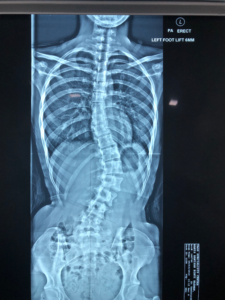
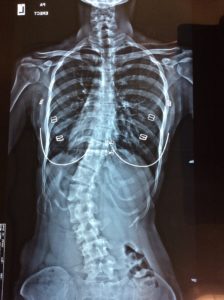
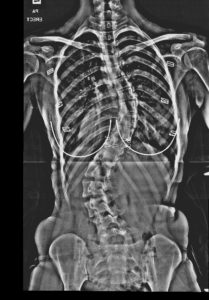
Most commonly noted is the 3D spinal deformity where patient’s spine is not only wedging laterally but suffer from anterior-posterior wedging and rotation as well. Scoliosis occurs most often during the growth spurt just before puberty and progress continuously during adolescence; hence it is commonly diagnosed in children age 10 and above.
Severity is measured by two factors: the angle of the curvature and age of bone maturity. The treatment approach for different severity stages differs.
- Mild Stage: If your child's spinal curve is less than 25° or if he or she is almost full-grown, your doctor may recommend simply monitoring the curve and ask for exercises to make sure it does not get worse. Your doctor will recheck your child about every 3 to 6 months and schedule follow-up x-rays until your child is fully grown.
- Moderate Stage: If the spinal curve is between 25° and 45° and your child is still growing, your doctor may recommend bracing. Although bracing will not straighten an existing curve, it often prevents it from getting worse to the point of requiring surgery.
- Severe Stage: If the spinal curve is above 50° and child still not yet fully in maturity (Most of them would get worse very fast) needs to do surgery to prevent the compression of organ from deviated spines to cause a life-threatening.
In a recent research study of scoliosis patients with curves at a high risk for worsening, bracing significantly decreased the incidence of curves that progressed to the point of needing surgery or delay the surgery until the child is mature that just need to do once only (Some of children need to adjust the screws of spines every 6 months due to still growing)
Research has proven that scoliosis is not merely a “musculoskeletal” problem but a more extensive “neuromusculoskeletal” problem; hence neural issues have to be taken into consideration as well.
Our Comprehensive treatment plan for Adolescent Idiopathic Scoliosis:
Please visit Our Services: